
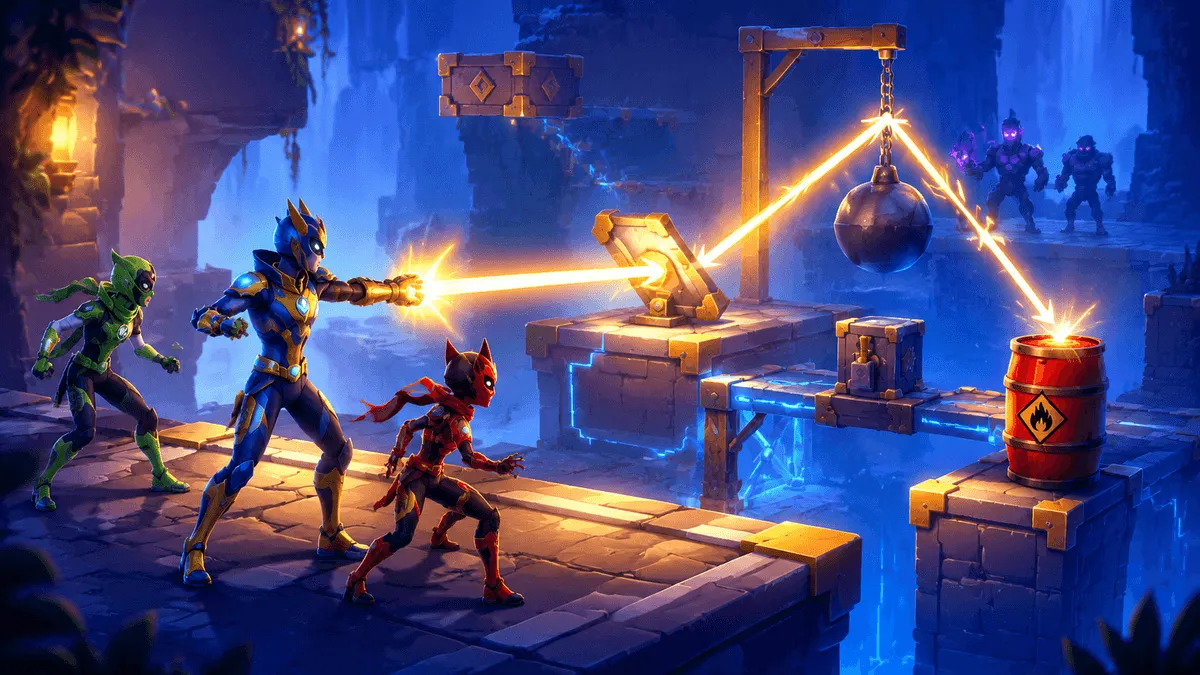
The Superhero League Powers and Puzzle Guide
This The Superhero League guide explains how to approach each mission as a physics puzzle. The active hero has a specific power, villains may be protected by walls or objects, and the most obvious target is not always the correct first target. A direct attack works when the route is open; otherwise, the environment becomes part of the solution.
The core control pattern is simple: click or hold to aim, drag when a direction is needed, and release to activate the power. The challenge comes from predicting what the ability will do after release. Moving one object can open a route, trigger a hazard, or create a chain reaction that reaches more than one enemy.
Quick takeaways
- Identify the active power before choosing a target.
- Inspect movable objects, walls, explosives, and open routes.
- Aim at the environment when a villain cannot be reached directly.
- Predict where objects will move after impact.
- Use the first action to change the board only when it creates a clear follow-up.
On this page: controls · powers · environment · solutions · mistakes · FAQ
Learn the Hold, Aim, and Release Controls
Most actions follow a hold, aim, and release rhythm. Press or hold on the screen, drag to establish the direction when the current ability allows it, and release to fire or activate the power. Touch input uses the same idea as mouse input.
Do not release as soon as the aiming line points toward a villain. Check whether a wall blocks the route, whether the target is supported by a movable object, and whether another environmental feature can produce a safer result. The short pause before release is where most of the puzzle solving happens.
When an action misses, identify why. A poor direction calls for a finer aim adjustment. A blocked route means the target choice was wrong, even if the line itself was accurate.
Read the Active Superhero Power
Different heroes use different abilities, so a solution that worked in the previous mission may not fit the next one. First ask what the active power changes: can it strike a target, move an object, pull something into a new position, or set off a useful part of the environment?
Then match the power to the level. A force that moves objects is valuable when a barrier can be displaced or dropped. A directed attack is useful when there is a clean route. A power that interacts with distant objects may make an indirect solution possible without exposing the hero to a poor angle.
This habit prevents a common mistake in The Superhero League powers puzzles: aiming at the nearest villain before understanding the tool provided for the mission.
Use Environmental Physics
Walls, movable pieces, falling objects, and explosives are not merely decoration. They can block one approach and create another. Scan from the villains outward and look for objects that could fall, slide, collide, or trigger a reaction.
Before acting, predict the sequence:
- Decide which object or villain the power will affect first.
- Estimate the direction that object will move.
- Check whether the movement opens a route or creates a hazard.
- Confirm that the result does not protect another villain more effectively.
- Release only when the chain has a useful final outcome.
Physics does not require a complicated chain every time. If one precise direct shot clears an exposed target, take it. Save indirect play for enemies that cannot be reached cleanly or when one environmental action can solve more of the board.
Compare Direct and Indirect Solutions
A direct solution targets the villain with the hero's ability. It is easy to judge and usually has fewer moving parts. Choose it when the line is open and the power can create the required result.
An indirect solution targets something else first. You might move a protective object, use a wall interaction, drop an item, or trigger an explosive feature near the enemy. Indirect play is useful because physics can reach around cover that the hero's initial line cannot cross.
Compare the two routes before spending an action. The best solution is the one with the fewest uncertain steps, not automatically the most dramatic chain reaction. If moving one barrier creates a guaranteed follow-up, it is a better plan than hoping several objects bounce into exactly the right positions.
Plan for Move Efficiency
Each action should either defeat a villain or improve the board for a specific next action. Moving an object without knowing the follow-up can close a route and make the mission harder.
Count the protected targets and decide which one controls the board. Removing an exposed enemy may be useful, but opening the central route can be more important if it makes two later attacks possible. Work backward from the final protected villain and preserve any object needed to reach that position.
Move efficiency is not about rushing. Take time before the first release because a good opening often determines whether the rest of the mission has a clean sequence.
Avoid Common Puzzle Mistakes
Several habits cause unnecessary restarts:
- Attacking the closest villain without checking the active power.
- Ignoring an explosive or movable object beside a protected target.
- Releasing while a wall still blocks the power's route.
- Triggering a chain reaction without predicting its final direction.
- Moving a useful object out of position before it completes its role.
If a solution fails, reset the reasoning rather than repeating the same aim. Ask whether the target, order, or environmental interaction was incorrect. A small aim change helps only when the original plan was sound.
Apply the Method in the Game
Open The Superhero League game on EaseGame and inspect the entire mission before touching the controls. Name the current power, identify every villain, and choose between a direct route and an environmental solution. Then hold, aim, and release only after you can explain what the first action should change.
That process fits both short introductory levels and later boards with more protected targets. The objects may change, but the decision order remains stable: power, target, obstacle, interaction, result.
Frequently Asked Questions
What are The Superhero League controls?
Click or hold to aim, drag when the active ability needs a direction, and release to use the power. On touch devices, use the same press, drag, and release sequence.
How do superhero powers work in the game?
Each active hero provides a different way to affect villains or level objects. Identify what the power can move, strike, or trigger, then choose a target that turns that ability into a useful result.
How do you defeat a villain behind a wall?
Look for an indirect physics solution. Move an obstacle, trigger a nearby hazard, use an explosive object, or create a route that lets a later action reach the protected position.
Is every puzzle solved with a direct attack?
No. Exposed villains may allow direct attacks, but protected enemies often require you to interact with walls, movable objects, falling items, or hazards first.
Conclusion
The Superhero League rewards deliberate puzzle reading more than rapid input. Learn the hold, aim, and release controls, identify the current hero power, and treat every environmental object as a possible part of the solution. When a direct route is blocked, plan an indirect interaction with a clear result instead of wasting an action.
August 24,2026